Madonna: when she doesn't try
Most people claim they hate Madonna because she 'tries too hard' and is always up in their face with Kabbalah or some over sexualized gimmick. This is true for some things, however, she really shows her talent and lasting quality by seeking out the latest euro producers and songwriters to stay current. Here are some jams you may have overlooked in the '90′s just because they were released under 'Madonna'.

'Bedtime Story' - by Bjork
'Take A Bow' - by Babyface
'Justify My Love' - by Lenny Kravitz
Don't Tell Me' by Madonna (2000)
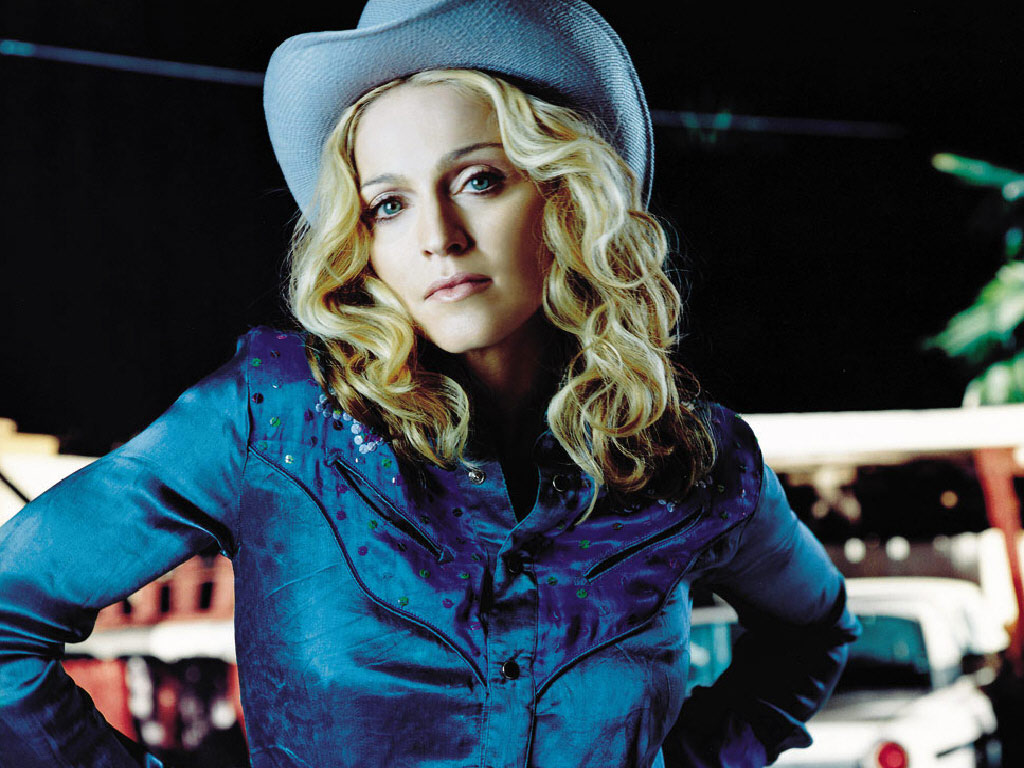
That enigmatic expression in the above photo, as the reigning Pop Icon of the 20th Century stares down the Millenium and her advancing years with a kind of shaky contempt, found its sonic counterpart in this single, which could handily act as Madonna's entire manifesto: she needs to be here, and be seen, and you could change the laws of nature before you could ever dream of stopping her.
The collaboration with Swedish knob-twiddler Mirwais yielded some or the most truly radical pop music in Madonna's career. Coming off the back of the lush but self-consciously 'mature' work she did with William Orbit on Ray of Light, the Music album saw Madonna reclaim a sense of delirious investment in what she's doing that had been shelved in favour of critic-wooing. Rather than pontificating vaguely (nigh on sanctimoniously) about love, or her dead mother, or the evils of mankind, the focus is upon Madonna's own insecurities, and thus she delivers a minor masterpiece like 'Don't Tell Me'.
Mirwais' jerky, stop-start stylings may infuriate some in their foregrounding of artificiality, but they're completely in service to a strained/pained vocal that expresses that quality that Madonna so often finds somewhat elusive: i.e. tangible humanity. Madonna's traded on her brashness and impudence to get where she is, but at a cost; 'Don't Tell Me' exposes the self-doubt that fuels her defiance.
Bonus points: Undaunted by the heinous legacy of Billy Ray Cyrus, Shania Twain and Steps, Madonna dabbles in some linedancing. Let the size of her balls never be questioned.59. 'Don't Tell Me' by Madonna (2000)
Cadillac-Jack™ Flash Back
Well, today was a BIG day in music history. It marked the beginning of what would become an icon in American music, It also marked the end of an icon in American music. First off, it was August 16, 1958 when Madonna Louise Ciccone entered this world. Today is her 52nd birthday, and below I have posted a video of my favorite Madonna song. It made it to #1 in 1989.
Nineteen years after Madonna was born, we lost Elvis. What can you say about Elvis Aaron Presley that you don't already know? We still miss The King. We miss him so much his estate makes more than $50 Million a year. The video below is a live version of the last single he had that made the Billboard Top-25 (#22 in 1977) and shows off his extreme talent as he READS the lyrics to a song he doesn't know the words to. By the way, in a mere 9 years, we will have been without Elvis for as long as he was on this earth……
Madonna
Cadillac-Jack™ Flash Back
Madonna: Plantation Mistress or Soul Sister?
Subversion is contextual, historical, and above all social. No matter how exciting the "destabitizing" potential of texts, bodily or otherwise, whether those texts are subversive or recuperative or both or neither cannot be determined by abstraction from actual social practice. - Susan Bordo
White women "stars" like Madonna, Sandra Bernhard, and many others publicly name their interest in, and appropriation of, black culture as yet another sign of their radical chic. Intimacy with that "nasty" blackness good white girls stay away from is what they seek. To white and other nonblack consumers, this gives them a special flavor, an added spice. After all it is a very recent historical phenomenon for any white girl to be able to get some mileage out of flaunting her fascination and envy of blackness. The thing about envy is that it is always ready to destroy, erase, take over, and consume the desired object. That's exactly what Madonna attempts to do when she appropriates and commodifies aspects of black culture. Needless to say this kind of fascination is a threat. It endangers. Perhaps that is why so many of the grown black women I spoke with about Madonna had no interest in her as a cultural icon and said things like, "The bitch can't even sing." It was only among young black females that I could find die-hard Madonna fans. Though I often admire and, yes at times, even envy Madonna because she has created a cultural space where she can invent and reinvent herself and receive public affirmation and material reward, I do not consider myself a Madonna fan.
Once I read an interview with Madonna where she talked about her envy of black culture, where she stated that she wanted to be black as a child. It is a sign of white privilege to be able to "see" blackness and black culture from a standpoint where only the rich culture of opposition black people have created in resistance marks and defines us. Such a perspective enables one to ignore white supremacist domination and the hurt it inflicts via oppression, exploitation, and everyday wounds and pains. White folks who do not see black pain never really understand the complexity of black pleasure. And it is no wonder then that when they attempt to imitate the joy in living which they see as the "essence" of soul and blackness, their cultural productions may have an air of sham and falseness that may titillate and even move white audiences yet leave many black folks cold. Needless to say, if Madonna had to depend on masses of black women to maintain her status as cultural icon she would have been dethroned some time ago. Many of the black women I spoke with expressed intense disgust and hatred of Madonna. Most did not respond to my cautious attempts to suggest that underlying those negative feelings might lurk feelings of envy, and dare I say it, desire. No black woman I talked to declared that she wanted to "be Madonna."
Yet we have only to look at the number of black women entertainers/stars (Tina Turner, Aretha Franklin, Donna Summer, Vanessa Williams, Yo-Yo, etc.) who gain greater crossover recognition when they demonstrate that, like Madonna, they too, have a healthy dose of "blonde ambition." Clearly their careers have been influenced by Madonna's choices and strategies. For masses of black women, the political reality that underlies Madonna's and our recognition that this is a society where "blondes" not only "have more fun" but where they are more likely to succeed in any endeavor is white supremacy and racism. We cannot see Madonna's change in hair color as being merely a question of aesthetic choice. I agree with Julie Burchill in her critical work Girls on Film, when she reminds us: "What does it say about racial purity that the best blondes have all been brunettes (Harlow, Monroe, Bardot)? I think it says that we are not as white as we think. I think it says that Pure is a Bore." I also know that it is the expressed desire of the nonblonde Other for those characteristics that are seen as the quintessential markers of racial aesthetic superiority that perpetuate and uphold white supremacy. In this sense Madonna has much in common with the masses of black women who suffer from internalized racism and are forever terrorized by a standard of beauty they feel they can never truly embody.
Like many black women who have stood outside the culture's fascination with the blonde beauty and who have only been able to reach it through imitation and artifice, Madonna often recalls that she was a working-class white girl who saw herself as ugly, as outside the mainstream beauty standard. And indeed what some of us like about her is the way she deconstructs the myth of "natural" white girl beauty by exposing the extent to which it can be and is usually artificially constructed and maintained. She mocks the conventional racist-defined beauty ideal even as she rigorously strives to embody it. Given her obsession with exposing the reality that the ideal female beauty in this society can be attained by artifice and social construction, it should come as no surprise that many of her fans are gay men, and that the majority of nonwhite men, particularly black men, are among that group. Jennie Livingston's film Paris Is Burning suggests that many black gay men, especially queens/divas, are as equally driven as Madonna by "blonde ambition." Madonna never lets her audience forget that whatever "look" she acquires is attained by hard work-"it ain't natural." And as Burchill comments in her chapter "Homosexual Girls": I have a friend who drives a cab and looks like a Marlboro Man but at night is the second best Jean Harlow I have ever seen. He summed up the kind of film star he adores, brutally and brilliantly, when he said, "I like actresses who look as if they've spent hours putting themselves together-and even then they don't look right." Certainly no one, not even die-hard Madonna fans, ever insists that her beauty is not attained by skillful artifice. And indeed, a major point of the documentary film Truth or Dare: In Bed With Madonna was to demonstrate the amount of work that goes into the construction of her image. Yet when the chips are down, the image Madonna most exploits is that of the quintessential "white girl." To maintain that image she must always position herself as an outsider in relation to black culture. It is that position of outsider that enables her to colonize and appropriate black experience for her own opportunistic ends even as she attempts to mask her acts of racist aggression as affirmation. And no other group sees that as clearly as black females in this society. For we have always known that the socially constructed image of innocent white womanhood relies on the continued production of the racist/sexist sexual myth that black women are not innocent and never can be. Since we are coded always as "fallen" women in the racist cultural iconography we can never, as can Madonna, publicly "work" the image of ourselves as innocent female daring to be bad. Mainstream culture always reads the black female body as sign of sexual experience. In part, many black women who are disgusted by Madonna's flaunting of sexual experience are enraged because the very image of sexual agency that she is able to project and affirm with material gain has been the stick this society has used to justify its continued beating and assault on the black female body. The vast majority of black women in the United States, more concerned with projecting images of respectability than with the idea of female sexual agency and transgression, do not often feel we have the "freedom" to act in rebellious ways in regards to sexuality without being punished. We have only to contrast the life story of Tina Turner with that of Madonna to see the different connotations "wild" sexual agency has when it is asserted by a black female. Being represented publicly as an active sexual being has only recently enabled Turner to gain control over her life and career. For years the public image of aggressive sexual agency Turner projected belied the degree to which she was sexually abused and exploited privately. She was also materially exploited. Madonna's career could not be all that it is if there were no Tina Turner and yet, unlike her cohort Sandra Bernhard, Madonna never articulates the cultural debt she owes black females.
In her most recent appropriations of blackness, Madonna almost always imitates phallic black masculinity. Although I read many articles which talked about her appropriating male codes, no critic seems to have noticed her emphasis on black male experience. In his Playboy profile, "Playgirl of the Western World," Michael Kelly describes Madonna's crotch grabbing as "an eloquent visual put-down of male phallic pride." He points out that she worked with choreographer Vince Paterson to perfect the gesture. Even though Kelly tells readers that Madonna was consciously imitating Michael Jackson, he does not contextualize his interpretation of the gesture to include this act of appropriation from black male culture. And in that specific context the groin grabbing gesture is an assertion of pride and phallic domination that usually takes place in an all-male context. Madonna's imitation of this gesture could just as easily be read as an expression of envy.
Throughout [many] of her autobiographical interviews runs a thread of expressed desire to possess the power she perceives men have. Madonna may hate the phallus, but she longs to possess its power. She is always first and foremost in competition with men to see who has the biggest penis. She longs to assert phallic power, and like every other group in this white supremacist society, she clearly sees black men as embodying a quality of maleness that eludes white men. Hence they are often the group of men she most seeks to imitate, taunting white males with her own version of"black masculinity." When it comes to entertainment rivals, Madonna clearly perceives black male stars like Prince and Michael Jackson to be the standard against which she must measure herself and that she ultimately hopes to transcend.
Fascinated yet envious of black style, Madonna appropriates black culture in ways that mock and undermine, making her presentation one that upstages. This is most evident in the video "Like a Prayer." Though I read numerous articles that discussed public outrage at this video, none focused on the issue of race. No article called attention to the fact that Madonna flaunts her sexual agency by suggesting that she is breaking the ties that bind her as a white girl to white patriarchy, and establishing ties with black men. She, however, and not black men, does the choosing. The message is directed at white men. It suggests that they only labeled black men rapists for fear that white girls would choose black partners over them. Cultural critics commenting on the video did not seem at all interested in exploring the reasons Madonna chooses a black cultural backdrop for this video, i.e., black church and religious experience. Clearly, it was this backdrop that added to the video's controversy.
In her commentary in the Washington Post, "Madonna: Yuppie Goddess," Brooke Masters writes: "Most descriptions of the controversial video focus on its Catholic imagery: Madonna kisses a black saint, and develops Christ-like markings on her hands. However, the video is also a feminist fairy tale. Sleeping Beauty and Snow White waited for their princes to come along, Madonna finds her own man and wakes him up." Notice that this writer completely overlooks the issue of race and gender. That Madonna's chosen prince was a black man is in part what made the representation potentially shocking and provocative to a white supremacist audience. Yet her attempt to exploit and transgress traditional racial taboos was rarely commented on. Instead critics concentrated on whether or not she was violating taboos regarding religion and representation.
In the United States, Catholicism is most often seen as a religion that has [few] or no black followers and Madonna's video certainly perpetuates this stereotype with its juxtaposition of images of black non-Catholic representations with the image of the black saint. Given the importance of religious experience and liberation theology in black life, Madonna's use of this imagery seemed particularly offensive. For she made black characters act in complicity with her as she aggressively flaunted her critique of Catholic manners, her attack on organized religion. Yet, no black voices that I know of came forward in print calling attention to the fact that the realm of the sacred that is mocked in this film is black religious experience, or that this appropriative "use" of that experience was offensive to many black folk. Looking at the video with a group of students in my class on the politics of sexuality where we critically analyze the way race and representations of blackness are used to sell products, we discussed the way in which black people in the video are caricatures reflecting stereotypes. They appear grotesque. The only role black females have in this video is to catch (i.e., rescue) the "angelic" Madonna when she is "falling." This is just a contemporary casting of the black female as Mammy. Made to serve as supportive backdrop for Madonna's drama, black characters in "Like a Prayer" remind one of those early Hollywood depictions of singing black slaves in the great plantation movies or those Shirley Temple films where Bojangles was trotted out to dance with Miss Shirley and spice up her act. Audiences were not supposed to be enamored of Bojangles, they were supposed to see just what a special little old white girl Shirley really was. In her own way Madonna is a modern day Shirley Temple. Certainly her expressed affinity with black culture enhances her value.
Eager to see the documentary Truth ar Dare because it promised to focus on Madonna's transgressive sexual persona, which I find interesting, I was angered by her visual representations of her domination over not white men (certainly not over Warren Beatty or Alek Keshishian), but people of color and white working-class women. I was too angered by this to appreciate other aspects of the film I might have enjoyed. In Truth or Dare Madonna clearly revealed that she can only think of exerting power along very traditional, white supremacist, capitalistic, patriarchal lines. That she made people who were dependent on her for their immediate livelihood submit to her will was neither charming nor seductive to me or the other black folks that I spoke with who saw the film. We thought it tragically ironic that Madonna would choose as her dance partner a black male with dyed blonde hair. Perhaps had he appeared less like a white-identified black male consumed by "blonde ambition" he might have upstaged her. Instead he was positioned as a mirror, into which Madonna and her audience could look and see only a reflection of herself and the worship of "whiteness" she embodies- that white supremacist culture wants everyone to embody. Madonna used her power to ensure that he and the other nonwhite women and men who worked for her, as well as some of the white subordinates, would all serve as the backdrop to her white-girl-makes-good-drama. Joking about the film with other black folks, we commented that Madonna must have searched long and hard to find a black female that was not a good dancer, one who would not deflect attention away from her. And it is telling that when the film directly reflects something other than a positive image of Madonna, the camera highlights the rage this black female dancer was suppressing. It surfaces when the "subordinates" have time off and are "relaxing."
As with most Madonna videos, when critics talk about this film they tend to ignore race. Yet no viewer can look at this film and not think about race and representation without engaging in forms of denial. After choosing a cast of characters from marginalized groups-nonwhite folks, heterosexual and gay, and gay white folks-Madonna publicly describes them as "emotional cripples." And of course in the context of the film this description seems borne out by the way they allow her to dominate, exploit, and humiliate them. Those Madonna fans who are determined to see her as politically progressive might ask themselves why it is she completely endorses those racist/sexist/classist stereotypes that almost always attempt to portray marginalized groups as "defective". Let's face it, by doing this, Madonna is not breaking with any white supremacist, patriarchal status quo; she is endorsing and perpetuating it.
Some of us do not find it hip or cute for Madonna to brag that she has a "fascistic side," a side well documented in the film. Well, we did not see any of her cute little fascism in action when it was Warren Beatty calling her out in the film. No, there the image of Madonna was the little woman who grins and bears it. No, her "somebody's got to be in charge side," as she names it, was most expressed in her interaction with those representatives from marginalized groups who are most often victimized by the powerful. Why is it there is little or no discussion of Madonna as racist or sexist in her relation to other women? Would audiences be charmed by some rich white male entertainer telling us he must "play father" and oversee the actions of the less powerful, especially women and men of color? So why did so many people find it cute when Madonna asserted that she dominates the interracial casts of gay and heterosexual folks in her film because they are crippled and she "like[s] to play mother" No, this was not a display of feminist power, this was the same old phallic nonsense with white pussy at the center. And many of us watching were not simply unmoved-we were outraged.
Perhaps it is a sign of a collective feeling of powerlessness that many black, nonwhite, and white viewers of this film who were disturbed by the display of racism, sexism, and heterosexism (yes, it's possible to hire gay people, support AIDS projects, and still be biased in the direction of phallic patriarchal heterosexuality) in Truth or Dare have said so little. Sometimes it is difficult to find words to make a critique when we find ourselves attracted by some aspect of a performer's act and disturbed by others, or when a performer shows more interest in promoting progressive social causes than is customary. We may see that performer as above critique. Or we may feel our critique will in no way intervene on the worship of them as a cultural icon. To say nothing, however, is to be complicit with the very forces of domination that make "blonde ambition" necessary to Madonna's success. Tragically, all that is transgressive and potentially empowering to feminist women and men about Madonna's work may be undermined by all that it contains that is reactionary and in no way unconventional or new. It is often the conservative elements in her work converging with the status quo that have the most powerful impact. For example: Given the rampant homophobia in this society and the concomitant heterosexist voyeuristic obsession with gay life-styles, to what extent does Madonna progressively seek to challenge this if she insists on primarily representing gays as in some way emotionally handicapped or defective? Or when Madonna responds to the critique that she exploits gay men by cavalierly stating: "What does exploitation mean? . . . In a revolution, some people have to get hurt. To get people to change, you have to turn the table over. Some dishes get broken." I can only say this doesn't sound like liberation to me. Perhaps when Madonna explores those memories of her white working-class childhood in a troubled family in a way that enables her to understand intimately the politics of exploitation, domination, and submission, she will have a deeper connection with oppositional black culture. If and when this radical critical self-interrogation takes place, she will have the power to create new and different cultural productions, work that will be truly transgressive-acts of resistance that transform rather than simply seduce.
- Bell Hooks, from "Black Looks: Race and Representation".Madonna: Plantation Mistress or Soul Sister?
100 GREATEST SINGLES OF ALL TIME - 70: MADONNA - DROWNED WORLD / SUBSTITUTE FOR LOVE
by Laurent Kelly

In 1998 Madonna highlighted a profound talent which she had not touched upon previously and which she has not been able to reach since. Still, Ray of Light stands up today as a stunning record - one filled with thought provoking, well produced and well written songs - each with good variety and pacing. From the collection the opening track Substitute for Love is my favourite. This is a brilliant song about the two dimensional nature of fame, a drug which can take you to great but shallow heights but which is no replacement for a real genuine feeling of self-worth and happiness. If Madonna had stayed down this path she might have gone on to become one of the true meaningful greats instead of settling for her Queen of Pop monikker. This record proved that she is better than that.
BEST LINE: I got exactly what I asked for / Wanted it so badly / Running, rushing back for more / I suffered fools so gladly.
THE 100 GREATEST SINGLES OF ALL TIME - 70: MADONNA - DROWNED WORLD / SUBSTITUTE FOR LOVE
This video, directed by Mark Romanek for Madonna in 1995, is a homage to artists and mystics who exp...
This video, directed by Mark Romanek for Madonna in 1995, is a homage to artists and mystics who explored the subconsciousness. it starts with Madonna, as some experimental or therapeutic subject, turns into some dream like state, the word "Lucid" appears on one of the screens. From a sterile, bright and high-tech-ish setting the video turns darker, more organic and mysterious. the visual vocabulary of this video contains quotations of three woman surrealist painters, here are some references:

Dorothea Tanning: Eine Kleine Nachtmusik, 1943

Remedios Varo: Los Amantes, 1955

Remedios Varo: Remenance

Leonora Carrington

Leonor Fini: The ends of the earth, 1949

Alongside these, this clip pays tribute to two films. first is the brilliant Armenian director Sergei Parajanov, and his beautiful, surrealistic film from 1968 "The Color of Pomegranates"
http://www.youtube.com/watch?v=m55eF3QmFuA&feature=related
The second, is the philosophic and psychedelic film "Stalker", By Andrei Tarkovsky:
I'm still trying to figure out the meaning of the rotating cube. it reminds me a bit of the idea of the cube of space - a model that represents human consciousness in various mystic and psychological theories.

the cube of space
Or the Metatron cube, that relates to sacred geometry:

From the feminine surrealism of the mother and witch archetype to the Whirling Dervishes, this clip is all about altered states of consciousness and the search for the divine. what was once in the realm of religious and mystic practice, later became the role of artists and poets, and now, say Madonna and Romanek, is present in pop culture, for millions of people to get a glimpse at.
This video, directed by Mark Romanek for Madonna in 1995, is a homage to artists and mystics who exp...
La Isla Bonita!
With the winning of Spanish in the World Cup 2010,
my mind pop in the song "La Isla Bonita" by Madonna!
I could remember I was like 5 or 6 when I first heard the song….
my big brother was a fan of her and its always on his walkman!!
La" Madonna
Well, it's time to celebrate this lady and share with you some of her great songs and preformances… Please enjoy!
Don't tell me
Vogue
Die another day
Hollywood
Live to tell
Like a virgin
Volume 156: "La" Madonna
Flashback Friday Video Madonna
We took a poll on Facebook and these were your favorite [lastfm]Madonna[/lastfm] songs! Big ups to our Facebook friends!

Click more, dance, and enjoy!
Express yourself
Mostly it was just the 'express yourself' line that was repeating itself in my head today. Not in context of the song at all… but still an important thing to do. Thanks Madonna.
i got the moves baby, you got the motion
who doesn't want some 80s madonna for the weekend ?
that's what i thought.

madonna // gambler
madonna // i know it
madonna // angel
madonna // dress you up
madonna // pretender
madonna // spotlight
madonna // who's that girl

♥
i got the moves baby, you got the motion
in this world
Madonna's foregrounding of sexuality falls into the category of third-wave feminism, with its edgy, in-your-face tactics. This type of feminism glorifies rebellion, whether it is directed at the patriarchal status quo or at second wave feminism's monolithic critique of gender, tendency toward "victim politics," and suspicion of non-normative sexuality.
Within Judith Peraino's proposed Garland-Ethridge-Madonna matrix of queer iconicity, Madge's 2000 hit What it Feels Like for a Girl neatly articulates what de Courtivron refers to as "the wish to be a woman." Anxiety accompanying such a wish drives much of Peraino's analysis, yet she critiques the recording What it Feels Like for a Girl as an invocation of an opposite desire, noting how "the lyrics describe…an inner wish for masculine power disguised by an outer mask of womanliness that serves to avert retribution." Yet the spoken intro to the song, daintily intoned in Madonna's faux British accent (this, I think, was the start of her British phase), is a direct address presumably not to her female fans but her male (queer?) listeners:
For a boy to look like a girl is degrading
'Cause you think being a girl is degrading
But secretly you'd love to know what it's like, wouldn't you?
Wish to be a woman, indeed! Peraino celebrates Madonna's acknowledgement of a polysexual fanbase, but in the music video version of What it Feels Like for a Girl, directed by her husband Guy Ritchie, the subjects to whom she addresses the song are perhaps most easily identified as heterosexual, even machismo males (an interpretation complicated by her concert version of the song, featuring backup dancers Peraino describes as "salsa dancing soft-butch women.").
For Peraino, the chief difference between the recorded and video versions of What it Feels Like for a Girl is gendered. The former she deems hyper feminized while the latter, with its dance beat and violent imagery, masculinized. Peraino's description of the video is great, and thorough. She reads Madonna as "a leather-clad female Robin Hood with tattoos and bruises, guns and Camaros. An elderly woman, whom she 'liberated' from an old folks home, rides as a catatonic 'shot gun' while Madonna commits gratuitous acts of violent mischief against men."
I want to offer an alternative reading, one that critiques Madonna's Judy Garland lineage as much as it perpetuates it. Let's say the song is addressed to the old lady.
To be sure, What it Feels Like for a Girl is a violent video, so much so that MTV banned it from the airways. Madonna rams her car into men whose only crime is grinning at her, she tasers a man from behind and steals his cash, hijacks a man's a car and then lights him on fire. And she buys the old lady a slurpy. When the shock of the first crash knocks the woman's glasses down her nose, Madonna pushes them back up again.
What does she want the old lady to see?
If Peraino is correct that third wave feminists rebel against the second wave's "tendency toward 'victim politics,'" then it's not simply Madonna's use of sex that places her squarely in the third wave: the video What if Feels Like for a Girl aggressively rejects female victimhood, belying the unthreatening femininity which the lyrics prescribe.
But I don't think the song is meant to chastise second wavers. Perhaps Peraino is right about Madonna's desire to "liberate" the old lady, but I'm not sure she's liberating her from the nursing home so much as from her beliefs about, yes, what it feels like for a girl in this world. The three words which, in the chorus, follow the titular phrase, are telling. This world, our world, is different from the world in which the old lady spent her girlhood, thanks in part to the hard work of second wave feminists, themselves probably at least a generation younger than the old woman in the video.
Judy Garland, perhaps a contemporary of Madonna's shotgun passenger, is beloved for what Peraino calls her "tragic queerness" but also for her resilience, especially in her "resistance to predictable repetitions of behavior." Generations later, Madonna is likewise iconic in her ability to reinvent her public image, yet her reinvention is unburdened by a pretense of victimhood. She's aware of the precedent of feminine feebleness, as the lyrics to What it Feels Like for a Girl assure us, but the video makes it clear that she's not beholden it. She comes out swinging from the start, and takes the old lady along for the joy ride.
-
Li
in this world


